Winter Emergency Health Guide: Risk Map and Decision Tree
Map of the most common winter emergencies — respiratory crises, cardiac events, trauma, hypothermia, carbon monoxide and viral infections — in a single decision tree.
- Medical review
- Nova Ambulans Sağlık Kurulu (Medical Board)Prepared with input from the Medical Board. AI-assisted draft.
- Published
- Last reviewed
- Reading time
- 7 min
Key takeaways
- Winter health risks are not a single seasonal event but a multi-variable map: respiratory, cardiac, trauma, environmental and viral.
- Common emergency thresholds: altered consciousness, central cyanosis, inability to speak in full sentences, or chest discomfort lasting more than a few minutes or that goes away and comes back.
- In the elderly, classic signs may be atypical — sudden confusion instead of fever, weakness instead of chest pain. Don't wait.
- Meteorological alerts + home/car preparation + close monitoring noticeably reduce risk; technical readiness buys time.
In this article (9 sections)
Winter emergency demand isn't driven by one disease; it rises from several risk factors operating simultaneously. Cold air narrows the bronchi, indoor crowding amplifies viral circulation, ice multiplies accidents, immobility primes cardiac events, and stove/water-heater carbon-monoxide poisoning arrives silently 14. This pillar guide consolidates the season's emergencies into a single decision map and routes you to the deeper spoke article for each scenario.
The winter health risk map
Five categories drive most winter ER and ambulance demand:
| Category | Common presentations | Typical victim profile | Spoke guide |
|---|---|---|---|
| Respiratory emergencies | Chronic Obstructive Pulmonary Disease (COPD) exacerbation, asthma attack, acute bronchitis, pneumonia | Existing Chronic Obstructive Pulmonary Disease (COPD)/asthma, elderly, children, immunocompromised | Winter respiratory emergencies |
| Cardiac events | MI, angina, acute heart failure, hypertensive crisis | Cardiac history, elderly, diabetics | Chest pain and shortness of breath in cold |
| Trauma from accidents | Traffic accidents, falls, head injury, hip fracture | Drivers, the elderly, pedestrians | Winter traffic accidents + hypothermia |
| Environmental exposure | Hypothermia, frostbite, stove burns | People living alone, elderly, outdoor workers | Winter traffic + hypothermia · Winter burns |
| Viral + poisoning | Flu, RSV, norovirus, CO poisoning | All age groups; CO for households using stoves/heaters | Flu season · Norovirus · Carbon monoxide poisoning |
Four things cold air does to the body
Same air, four simultaneous physiological effects:
- Narrows bronchi (reflex bronchospasm) — primary trigger of Chronic Obstructive Pulmonary Disease (COPD)/asthma exacerbations.
- Vasoconstricts peripheral vessels — blood pressure rises, cardiac workload increases, cardiac event risk increases.
- Thickens blood — dehydration plus vasoconstriction raises thrombosis risk.
- Weakens immune response — cold exposure increases susceptibility to upper-respiratory infections.
The convergence of these four mechanisms is what makes winter emergency demand structurally different from other seasons.
Single decision tree: when to call 112 / Nova Ambulans
Winter health raises a lot of "should we wait it out?" questions. Any of the following means don't wait — call.
Common signs that always warrant an ambulance
- Altered consciousness — drowsiness, agitation, confusion, lethargy. May be the first pneumonia sign in the elderly 1.
- Cyanosis — blue lips, tongue or nail beds. Respiratory failure or CO poisoning.
- Speech difficulty — can't form a sentence, single-word answers. Respiratory or cardiac crisis.
- Chest discomfort lasting more than a few minutes, or that goes away and comes back — especially radiating to arm/jaw with cold sweat. The American Heart Association (AHA) urges you not to wait and to call 112 for "chest discomfort that lasts more than a few minutes, or that goes away and comes back" 6.
- Loss of consciousness — even brief.
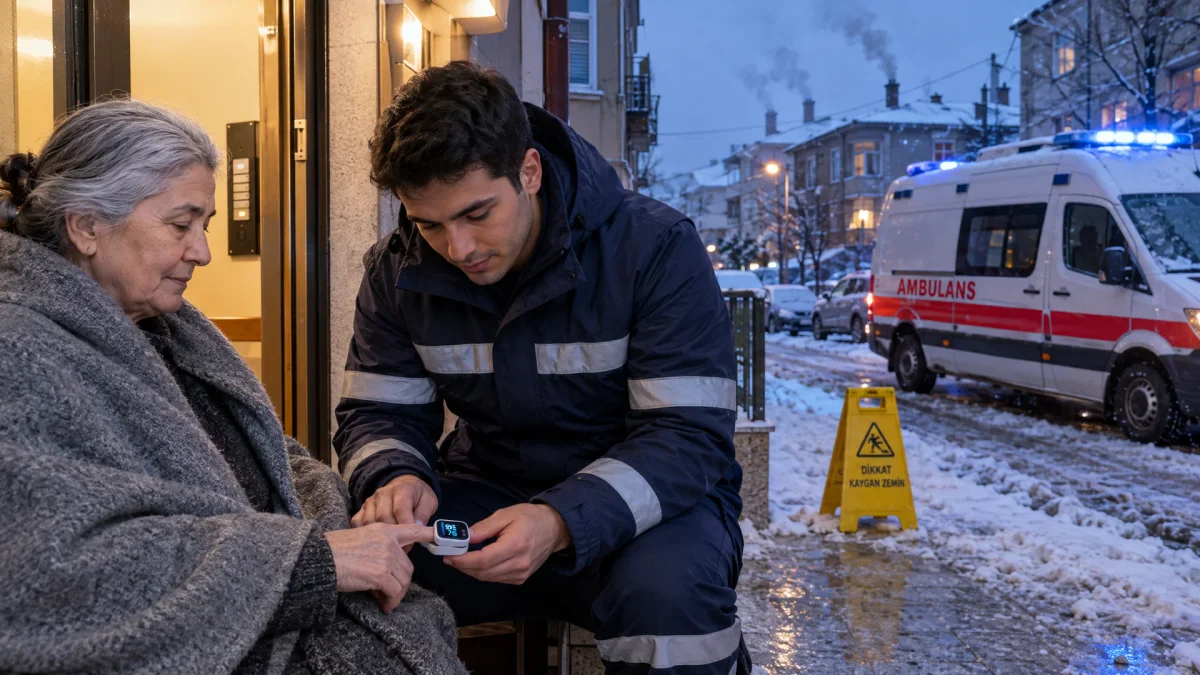
- Pulse oximeter SpO₂ ≤91% — particularly with dyspnoea (in the general population <94% is low and <90% is significant hypoxaemia) 8.
- Hypothermia: core temperature <35 °C 4; in advanced stages shivering has stopped.
- Fall + can't bear weight (especially elderly) — hip fracture + hypothermia combination.
- Frostbite — pale/bluish hardened skin; don't rub, plan transport to warmth.
- Infant/child: rapid breathing + chest retractions + refusal to feed.
Note (for COPD patients): Known Chronic Obstructive Pulmonary Disease (COPD) patients usually live at a lower baseline SpO₂ (88–92%) 8. For them the generic 91% threshold can be misleading; they should follow their own physician's target range and their usual readings rather than the flat cutoff.
When you can drive yourself to the ER instead
These usually require same-day ER evaluation but are not life-threatening if you go yourself:
- Fever >38.5 °C + 24–48-hour worsening flu-like illness
- Mild–moderate dyspnoea, SpO₂ ≥94% stable, alert
- No chest pain, stable pulse
- Post-fall with no clear sign but wanting evaluation
- Controlled pain, able to walk
If you drive yourself and deteriorate en route, intervention capacity is limited; an equipped ambulance starts treatment from dispatch.
Pre-winter preparation — concrete checklist
112 emergency calls are coordinated through the national Emergency Health Automation System (ASOS) infrastructure 2. In winter the burden of respiratory, cardiac and carbon-monoxide emergencies rises 1; three household measures meaningfully reduce that burden and your own need to call for help.
Home
- Carbon-monoxide detector (near bedrooms and kitchen)
- Annual stove and water-heater service
- Medications complete — especially inhalers, nitrates, beta-blockers, antihypertensives
- Pulse oximeter (if a household member has Chronic Obstructive Pulmonary Disease (COPD)/asthma/heart failure)
- Thermometer, analgesic, oral rehydration solution (for norovirus)
- Warm blanket + thermal duvet
- Charged flashlight, phone power bank
Car
- Reflectors + warning triangle (legal)
- Thermal/Mylar blanket
- High-visibility vest
- First-aid kit
- De-icer spray, scraper
- Spare water and durable food
Personal
- Flu + pneumococcal (pneumonia) vaccines — recommended for adults aged 65 and over, plus risk groups of any age (chronic lung/heart disease, diabetes, pregnancy, immunosuppression) 9
- Annual check-up — inhaler/medication plan review for Chronic Obstructive Pulmonary Disease (COPD)/cardiac patients
- Emergency contact list (physician, pharmacy, 112, Nova Ambulans)
- Address + building access info (apartment code, lift status) — to share with ambulance crew
Meteorological alerts + planning
Checking the Turkish State Meteorological Service's orange and red bulletins at the start of the day helps reduce fall and accident risk when planning trips, hospital visits or intercity transfers 3. Especially:
- Taking an elderly relative to a routine appointment
- Before a dialysis appointment
- On a planned intercity transfer date
- Before an outdoor event or a child's sports activity
A glance can be the difference between postponing a plan one day or not.
Detailed guides for each winter emergency
The articles below cover each scenario in clinical depth:
- Winter respiratory emergencies — Chronic Obstructive Pulmonary Disease (COPD) exacerbation, asthma attack, bronchitis, pneumonia. SpO₂ table, paediatric warnings, atypical pneumonia in the elderly.
- Chest pain and shortness of breath in cold — cardiac triggers in cold, distinguishing MI from respiratory crisis.
- Winter traffic + hypothermia — scene safety, spinal injury, hypothermia stages, frostbite management.
- Calling an ambulance during heavy snow — address sharing, building access, expected delay management.
- Winter burns at home — stove/heater burns, depth assessment, when to call.
- Carbon monoxide poisoning — the silent killer; headache + nausea + altered consciousness triad.
- Norovirus and stomach flu — dehydration, monitoring children + elderly.
- Flu season guide — flu vs cold, vaccine, when to call.
Conclusion
In practice, the winter emergency landscape is not a single disease but a map of overlapping risks. The same elderly person can develop pneumonia, fall on ice, and slide into hypothermia all in one morning. Four household-level measures — the checklist, daily met-service alerts, a pulse oximeter + CO detector, and the discipline of "don't wait if chest pain lasts more than a few minutes or keeps coming back, or SpO₂ <91%" — concretely raise your readiness for the season.
Frequently Asked Questions
What are the most common winter emergencies?
Respiratory emergencies (Chronic Obstructive Pulmonary Disease (COPD)/asthma/pneumonia), cardiac events, traffic accidents + falls, hypothermia/frostbite, and carbon-monoxide poisoning are the five leading categories 12. They often overlap — a fallen person may also develop hypothermia.
How do I monitor an elderly relative's winter health risks?
Sudden confusion or a fall instead of fever; weakness instead of chest pain — atypical presentations are common 1. A pulse oximeter + thermometer + daily phone check are the practical trio. Daily met-service alerts are basic planning tools 3.
How do I prevent CO poisoning?
Place a CO detector near bedrooms and the kitchen; service stoves yearly; clean chimneys; never run a vehicle in a closed garage; if you experience the headache + nausea + weakness triad, get outside immediately and call 112 4.
Do I need a pulse oximeter at home?
If a relative has Chronic Obstructive Pulmonary Disease (COPD), asthma, heart failure, or is elderly — yes, it's a useful winter decision aid. Cold fingers or motion can produce inaccurate readings 5.
112 or Nova Ambulans in winter?
112 routes to the nearest public hospital — the classic choice in life-threatening situations. Nova Ambulans (+90 216 339 00 39) transports to the private hospital of your choice and operates 24/7 with equipped vehicles 2. For altered consciousness, advanced hypothermia or suspected MI, both are appropriate.
Sources
Numbers in the text refer to the sources below.
- Public Health General Directorate of Türkiye (HSGM) (opens in a new tab)T.C. Ministry of Health
- Directorate General of Emergency Health Services (Türkiye) (opens in a new tab)T.C. Ministry of Health
- Turkish State Meteorological Service — Severe Weather Bulletins (opens in a new tab)Turkish State Meteorological Service
- CDC — Winter Weather: Before, During, and After (opens in a new tab)U.S. Centers for Disease Control and Prevention (CDC)
- WHO — Emergency and Critical Care (opens in a new tab)World Health Organization (WHO)
- AHA — Warning Signs of a Heart Attack (opens in a new tab)American Heart Association
- AAFP — Clinical Recommendations (opens in a new tab)American Academy of Family Physicians (AAFP)
- BTS Guideline for Oxygen Use in Healthcare and Emergency Settings (opens in a new tab)British Thoracic Society (BTS)
- Türkiye Ministry of Health Vaccine Portal — Adult Immunisation (opens in a new tab)T.C. Ministry of Health
Nova Ambulans Sağlık Kurulu (Medical Board)
Periodically reviewed by our editorial board of emergency physicians, paramedics and clinical coordinators.
This content is informational only and does not replace professional medical evaluation. In emergencies, call 112 or +90 216 339 00 39.