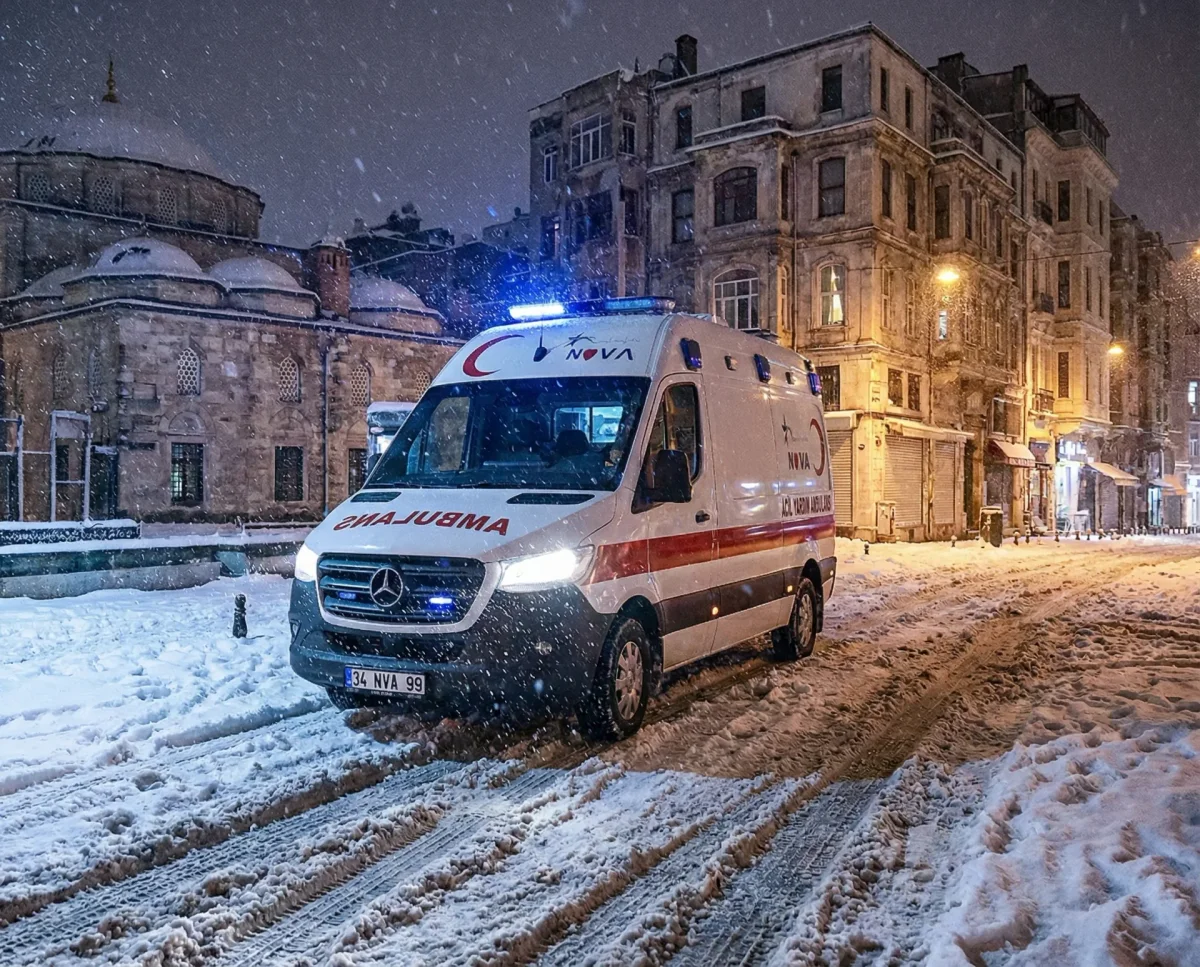
- Sharing your precise location via a map link when calling an ambulance during heavy snow can save lives.
- Do not go outside on icy ground to meet the ambulance; stay in a safe location and keep your phone line open.
- In life-threatening situations, call 112 or Nova Ambulans (0216 339 00 39) -- both provide 24/7 emergency response.
- For intercity transport, alternative routes and patient stability must be evaluated together.
Heavy snowfall, icy conditions, and sudden road closures during winter make emergency healthcare access even more critical. A distance that normally takes a few minutes can be extended significantly by snow-clearing operations, chain checkpoints, and traffic accidents. The answer to the question "How quickly does an ambulance arrive in Istanbul?" can vary dramatically in winter conditions.
This guide covers practical steps for calling an ambulance during heavy snow and road closures, including how to share your location accurately, wait safely, and plan patient transport.
Important: In any life-threatening situation, call 112 or Nova Ambulans (0216 339 00 39) immediately -- both provide 24/7 emergency ambulance response. The difference is hospital destination: 112 transports to the nearest public hospital, while Nova Ambulans can take you to the private hospital of your choice. This article is for informational purposes and does not replace medical evaluation.
Why Do Heavy Snow and Road Closures Complicate Emergency Response?
Road authority data consistently shows that heavy snowfall affects not just driving but also emergency medical response [1][6]. The Turkish State Meteorological Service (MGM) issues regional severe-weather warnings -- "measures to be taken for severe meteorological events" -- that callers should consult before requesting ambulance dispatch in cold months [4]. Globally, the World Health Organization estimates that "approximately 1.19 million people die each year as a result of road traffic crashes," with crashes costing "most countries 3% of their gross domestic product" -- a risk that climbs sharply during winter [5]:
- Traffic flow drops: Average speeds decrease sharply, extending ambulance arrival times.
- Road closures and barriers: Even when main roads are cleared, side streets may remain blocked.
- Black ice: Braking distances increase and accidents multiply. [1]
- Chain and equipment requirements: Some routes become impassable without tire chains.
- Intercity transport plans are disrupted: Highway and mountain pass closures require alternative routing. [1]
Accurate information sharing and safe waiting at the scene directly affect the speed and safety of emergency intervention. [1]
Emergency Calls: 112 and Nova Ambulans
When Should You Call 112 or Nova Ambulans?
Call 112 or Nova Ambulans (0216 339 00 39) without delay in these situations:
- Chest pain, shortness of breath, loss of consciousness
- Stroke signs (facial drooping, arm weakness, speech difficulty)
- Severe bleeding, major trauma, traffic accident
- Seizures, severe allergic reaction (anaphylaxis)
- Advanced hypothermia (extreme shivering that stops, confusion, altered consciousness) [2][3]
For detailed guidance on hypothermia, see our guide on winter frostbite and hypothermia risk.
When Does a Private Ambulance Make Sense?
During heavy snow periods, patient transport needs (non-emergency but requiring medical supervision) may require a planned, well-equipped approach:
- Supervised transfer from hospital to home or home to hospital
- Bedridden patient transport
- Intercity transport (if road conditions permit)
- Transfers requiring oxygen, monitoring, or an attendant
Nova Ambulans provides private ambulance service in Istanbul with winter-appropriate equipment and route planning for safe patient transfers.
How to Share Your Location When Calling an Ambulance During Heavy Snow
One of the most common problems during heavy snowfall is that ambulance crews approach the address but cannot find the exact location. A "we are on the street but cannot see the building" delay can be critical in emergencies.
1) Give a Full Address Plus Landmarks (Together)
Simply saying "X Neighborhood, Y Street" may not be enough. Include:
- Neighborhood, street/avenue, building number, floor/apartment, plus
- A nearby landmark: Grocery store, mosque, school, metro exit, or bus stop
- Building entrance: Where is the main door? Is it a residential complex or a standalone building?
- Road conditions: "The end of the street is blocked; entry is only possible from A Avenue."
2) Share a Map Link (WhatsApp/SMS)
If possible, send your location from your smartphone:
- Drop a pin in Google Maps and share the location link
- Live location sharing (if available) is extremely helpful as the crew approaches
- If inside a residential complex: include block name/number and gate code/turnstile information
3) Coordinates and Floor Information (Especially for Large Complexes)
For apartment complexes, shopping malls, and office buildings, the following details speed up the response:
- Block, entrance, security checkpoint
- Is the elevator working? Will stairs be needed?
- What floor is the patient on? A stretcher/stairway plan may be required.
4) Keep Your Phone Reachable -- This Is Critical
Due to heavy snow, the crew may need to use alternative routes. To avoid missing callback attempts:
- Turn your phone ringer on (vibrate alone may not be enough)
- Use a power bank if battery is low
- Provide a second contact number (neighbor, family member)
How Does an Ambulance Reach You During Road Closures? (Realistic Expectations)
During snowfall, ambulances generally use main roads, but blocked side streets can make even the "last 200 meters" difficult. In such cases:
- The crew approaches to the nearest safe point
- If needed, a meeting point is arranged with the patient's family (if road permits)
- Brief delays may occur due to snow-clearing or tow truck operations
Maintaining clear communication and safety is essential. Incorrect directions can put both the patient and the crew at risk.
Safe Waiting: What to Do Until the Ambulance Arrives
The biggest risks during heavy snow are falls, hypothermia, carbon monoxide poisoning, and panic. Our carbon monoxide poisoning in winter guide offers critical safety information for this period. Follow these steps while waiting:
If You Are Waiting at Home
- Position yourself where you can hear the doorbell or door knocking
- Make the building entrance visible if possible (turn on exterior lights)
- Do not go outside to "look for the ambulance" due to road anxiety (fall risk on ice)
If You Are Outdoors (Street/Car/Public Transport)
- Do not run on icy surfaces; fall injuries are very common
- Move to a wind-sheltered location in open areas
- Change wet clothing if possible; if not, add a dry layer on top
- If waiting inside a vehicle, make sure the exhaust pipe is not blocked by snow (CO poisoning risk) [3]
Should You Go Out to the Front of the Building?
Unless there is an urgent reason and the ground is very slippery, going outside to wait for the ambulance is generally not recommended. However, you can coordinate a "safe meeting point" with the crew by phone. Especially during road closures, the crew will plan the safest approach in coordination with you.
Sharing Health Information During a Winter Emergency (Speeds Up Response)
Having the following information ready when calling an ambulance accelerates the response:
- Patient's age; is the patient conscious?
- Breathing status; is there chest pain?
- Existing conditions (Chronic Obstructive Pulmonary Disease (COPD), heart failure, diabetes, etc.)
- Current medications and known allergies
- Symptom changes over the last 24 hours (fever, fall, fainting)
This information helps both 112 and private ambulance crews arrive prepared with the right equipment. Our guide for relatives waiting for an ambulance offers additional practical advice for this process.
Winter Tires, Chains, and Equipment: How They Affect Transfer Safety
Safe patient transport during heavy snow depends not only on speed but on proper equipment. Critical factors on the ambulance side include:
- Winter tires and chains when needed
- Proper stretcher transfer techniques on slippery surfaces
- Core emergency equipment: oxygen, monitors, suction devices
- Blankets and insulation to prevent the patient's heat loss [2]
Even on short-distance transfers during heavy icing, fall and chilling risks must be minimized during loading and transport.
Intercity Transport: How to Plan During Heavy Snow
Heavy snowfall affects not only city driving but also intercity ambulance service operations. Highway closures and route changes mean transport plans should never rely on a single route.
1) Road Conditions and Alternative Routes
- Highways, bridges, and connector roads can close suddenly
- Alternative routes must be identified; extended travel times should be evaluated against the patient's stability
2) Patient Stability and Transport Level
- Oxygen needs, IV access, and monitoring requirements are assessed
- For some patients, transport can be delayed; for others, any delay is risky
3) Acceptance and Preparation at Destination
- Confirm the receiving hospital's acceptance status, bed availability, and Intensive Care Unit (ICU) capacity in advance
- Hospital entrances and ER departments may be busier during snowfall
Nova Ambulans plans intercity transfers during winter conditions by evaluating route + timing + equipment together for a more predictable process. Our guide on safety in intercity ambulance transport on the highway covers this topic in greater depth.
Frequently Asked Questions
Q: How long does a 112 ambulance take during heavy snow? A: Under normal conditions in urban areas like Istanbul, 112 crews reach the large majority of cases within the first 10 minutes (Ministry of Health data: roughly 93% within the first 10 minutes in urban areas) [7]. However, in extraordinary conditions such as heavy snow, ice, and road closures, this time can lengthen significantly and exceed 30 minutes. Both 112 and private ambulances are affected by these conditions. This is an estimate, not a guarantee; sharing precise location information and keeping communication open helps reduce delays. Nova Ambulans also provides 24/7 emergency response and may offer an alternative when 112 lines are congested.
Q: Can I call a private ambulance during snowfall? A: Yes. For non-emergency transfers that require medical supervision, private ambulance service is available. Nova Ambulans provides winter-equipped vehicles and route planning.
Q: How will an ambulance reach me if the road is closed? A: Ambulance crews identify alternative routes and, if needed, establish a meeting point to approach the nearest safe location. Keeping your phone available and providing road condition updates accelerates this process.
Q: Is there a risk of carbon monoxide poisoning while waiting in a car during snow? A: Yes. If the exhaust pipe becomes blocked by snow, CO can accumulate inside the vehicle. Crack a window periodically while waiting and ensure the exhaust remains clear.
Q: Should intercity transport be postponed due to snow? A: The patient's clinical stability is the determining factor. If there is a life-threatening risk, delay is not appropriate. If conditions are stable, waiting for roads to improve can be considered. This decision should be made together with the medical team.
Rapid Emergency Support
24/7 emergency ambulance service across Istanbul. Fast response, fully equipped team.
Average response time: 15 seconds
Related Articles
Ambulance Personnel Training Standards: 2026 Regulation Update
The 8 January 2025 and 24 June 2025 regulatory amendments made ministry-designated training modules mandatory for every ambulance health worker in Türkiye: hour breakdown, certification cycle, and a family verification checklist.
EducationSepsis Symptoms: Flu or Sepsis? How to Spot It at Home and When to Call 112
Sepsis is an emergency in which the body responds to an infection in an extreme, uncontrolled way, and it can worsen within hours. If someone with a fever or an infection becomes confused, breathes very fast, has pale or blotchy skin, a rash that does not fade when pressed, or a very high or very low temperature, call 112 without waiting. Until the ambulance arrives, do not leave them alone, give them nothing by mouth and check their consciousness every 2-3 minutes.
EducationWhat to Do When an Older Person Falls at Home: 4 Checks Before Lifting and the 112 Decision
When an older relative falls at home, do not lift them straight away. First check consciousness and breathing, then whether they hit their head, then for pain, deformity or shortening in the hip or leg. If there is a suspected fracture, a head injury or they cannot get up on their own, call 112; if there is no injury, help them get up slowly under their own power and have a doctor see them the same week.
Popular Ambulance Topic Clusters
You may also like
- Private ambulance pricing
- Istanbul private ambulance
- Intercity patient transport
- Doctor-accompanied ambulance
- Dialysis patient transport
- How intercity patient transport works
- Ambulance response time in Istanbul
- Home-to-hospital patient transport
- Modern ambulance equipment and team standards
- Heart attack symptoms and first response
This content is informational only and does not replace professional medical evaluation. In emergencies, call 112 or +90 216 339 00 39.
